Service · Automation
Industrial automation for plants and production lines
Conceptech is an industrial automation company in Israel: custom machines, machine vision QC, test stations, HIL rigs and motion control, plus service and maintenance for machines from other builders.
Line down? 052‑521‑2844 Get urgent help
Full automation for a building-products plant · Service for machines built in Germany, Italy, Israel, China and Taiwan
FIG. 01, illustrative schematic: a control cabinet drives three pneumatic stations over I/O lines while a conveyor indexes the parts
- PLC and fieldbusModbus, CAN, RS-485
- HMI screenScreens and alarms
- Machine-vision QCA failed part goes to the reject bin
- Pneumatics and motionCylinders, valves and drives
- For
- Plant and engineering managers with manual stations, slow tests or machines that stop
- You get
- Tested at our workshop and at your plant (FAT/SAT); documentation, training, service
- First step
- A call with an engineer, then a line assessment on site and written requirements
From our projects
What does this look like on delivered projects?
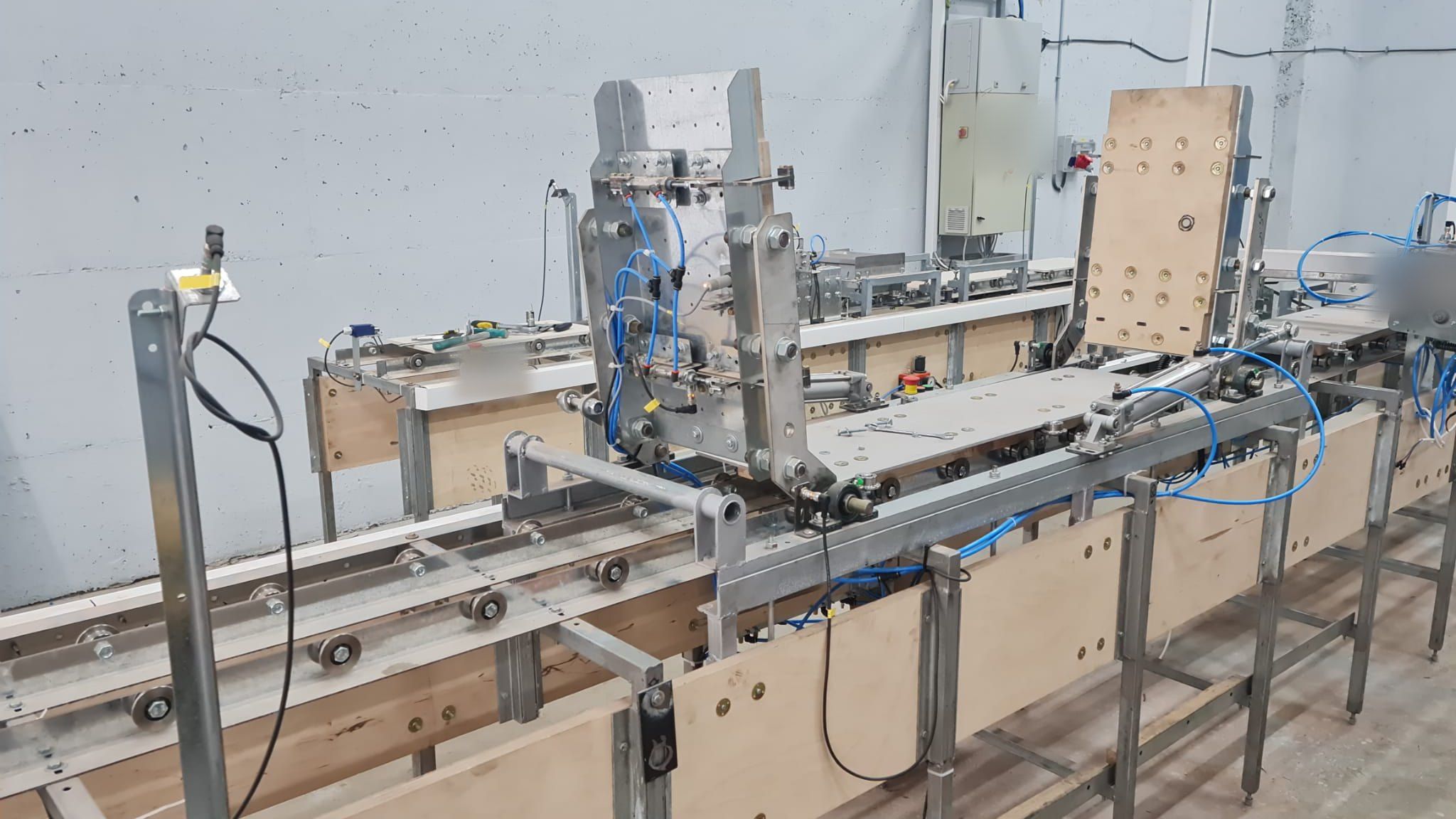
Full automation for a building-products plant
We joined mid-build and delivered the entire automation, from conveyor and motors to controls. In operation, with video.
Automated saw lines back in operation
Many lines at an aluminium plant had no documentation or vendor support. Back in operation in under one business day.
Automation services
Which automation service fits your line?
Industrial automation is the design and build of systems that take over manual work on the production line: custom machines, machine vision, test stations and motion control, plus service for the machines already on your line.
01
Custom machine design and build
From a process description to a machine running on your line: scoping, concept and ROI, design, build and acceptance tests.
02
Machine vision for quality control
A camera, lighting and software that check every part on the line, starting with a feasibility test on real samples.
03
Automated test stations (ATE)
A fixture, instruments and software that run the same test procedure on every unit and log the result.
04
HIL test benches for controllers
A simulated world around your controller or board, so the software is tested automatically on every change.
05
EtherCAT motion control and PLC programming
Axes and drives, the controller, the fieldbus and the operator interface, for new machines and retrofits.
06
Machine service and maintenance
Troubleshooting, preventive maintenance and control retrofits, including machines from other builders.
When it fits
When does automation make sense for your plant?
Five situations where automation usually pays off. And sometimes the answer is no: when volumes are low or the process is still changing, stabilise it first.
A manual station limits the line's throughput
The whole line waits on one station. A custom machine or automated cell there can remove the bottleneck.
Inconsistent quality and inspection by eye
People inspect by eye, so results depend on the shift. Machine vision checks every part against the same criteria and keeps a record.
End-of-line testing is the bottleneck
Manual testing is slow and hard to repeat the same way. An automated test station runs the same procedure on every unit and logs the results.
A machine or PLC nobody can maintain anymore
The program is undocumented, parts are hard to get and whoever built it has left. A controls, drives and HMI retrofit brings it back under control.
No data on what the line is doing
It's unclear where and why the line stops. Sensors, a controller and data collection show the picture, so you fix the right problem.
Automated cell
What does a typical automated cell look like?
A generic example of a cell that replaces a manual station: five steps each part goes through, and one controller that runs them all.
01
Infeed: the part enters the cell
A conveyor, tray or manual load. A sensor confirms the part has arrived and is in position.
02
Fixture: the part is held precisely
A fixture holds the part in the same position every time, so the operation and the check are repeatable.
03
Operation: actuator, axis or robot
The task itself, such as assembly, screwing, marking or transfer, with motion control from the controller.
04
Check: a camera confirms the result
Machine vision checks every part, and parts that fail the criteria are diverted.
05
Outfeed and records
The part moves on down the line and the result is logged, so you have data on every part and on the whole line.
Process
From site visit to handover: how does a project run?
We start with a line assessment and commit to one phase at a time. All six phases have a defined deliverable, and the system is tested at the workshop and again at your plant. Durations are estimated after the initial evaluation.
01 · URS
Line assessment and requirements
We visit the plant, watch the station at work and gather data on throughput and faults. We weigh the options, including a simple process fix, and define what the system must do.
Output: User requirements (URS) and constraints
Gate: You approve the requirements
02
Concept and feasibility
An initial cell layout and technology choice, and where needed a feasibility test on real parts, for example for machine vision.
Output: Concept layout, risk list and proposal
Gate: You approve the concept and the detailed-design proposal
03
Detailed design
Mechanical design, electrical schematics and the control panel, and the architecture of the control software, including the operator interface.
Output: Mechanical CAD, electrical schematics and panel layout, software architecture
Gate: Joint design review before parts are made
04 · FAT
Build and FAT
We build and wire the system, write the control software and run a factory acceptance test (FAT) at the workshop, against a protocol you approved.
Output: FAT protocol and results
Gate: The system passes FAT
05 · SAT
Installation and SAT
We install at your plant around your shifts, run the site acceptance test (SAT) and train operators and maintenance staff.
Output: SAT results, training and documentation
Gate: You sign off on the system
06
Support
Service on call-out or under a service plan, with a technical log for each system.
Output: Service plan and technical log
Project success
How do we make sure your project succeeds?
One phase at a time, with your sign-off
We commit to one phase at a time, and each phase has a defined deliverable. You approve the requirements and the concept before detailed design.
Acceptance tests at our workshop and at your plant
The system is tested at our workshop before shipping, against a protocol you approved (FAT), and again at your plant before handover (SAT).
Handover with documentation and training
After the site test we train your operators and maintenance staff and hand over the documentation. Handover ends when you sign off on the system.
A technical log for every system
Every service visit ends with a report: what we found, what we fixed and what to plan next. The reports are kept in a technical log for each system.
A service plan after handover
A monthly bank of hours, priority on service calls, and after-hours and weekend call-outs. Cancel any time with one month's notice; call-out service is available too.
Service and maintenance
Do you service and maintain existing machines?
Yes, including machines and equipment from other builders, not only systems we built. We service machines built in Germany, Italy, Israel, China and Taiwan.
Among other work, we've serviced many automated saw lines at an aluminium plant, mostly built in Taiwan, that were delivered with no documentation or vendor support. We worked them out and had them back in operation in under one business day.
There are two ways to get service:
- On call-out: you report a fault by email or phone, we usually reply within 3 working hours, then diagnose and fix it.
- Under a service plan: a monthly bank of hours, priority on service calls and a technical log for each system. The plan also covers after-hours and weekend call-outs, and you can cancel it at any time with one month's notice.
Choosing a controller
PLC or microcontroller: which fits your machine?
A PLC is the natural choice when the machine has to meet safety standards, when your maintenance team needs to look after it themselves, and when it works alongside other industrial equipment. The program is written in standard IEC 61131-3 languages, and it's easy to find people who know them.
A microcontroller on a custom board fits when you need flexibility, a low unit cost or special performance, mainly in equipment that doesn't need certification, such as in-house test rigs or small-volume special equipment. The downside: fewer people can maintain it.
Sometimes the answer is a combination: a PLC for control and safety, and a PC or microcontroller for machine vision, data collection or testing. We make the decision together during scoping, based on certification, maintenance and volume requirements.
Industrial automation FAQ
Can you upgrade an existing machine instead of replacing it?
Yes, and upgrading an existing machine is often the right move, even when another builder supplied it. A retrofit can include a new controller, drives and sensors, an operator interface or a camera check, built on the existing machine. We start by assessing the machine to decide what's worth replacing and what to keep.
Do you service machines you didn't build?
Yes. Conceptech services third-party machines and equipment, with extensive experience in aluminium plants and in food and beverage plants: edible oils, salads and soft drinks. We start by understanding the machine, its controller and the existing documentation, then diagnose and fix, on call-out or under a service plan.
Do you work with the PLCs and equipment we already have?
Generally yes: the new system is designed to connect to the controllers and equipment already in your plant. We work with Siemens, LS Electric, Unitronics and Controllino PLCs, and with Modbus, CAN bus, RS-485 and EtherCAT among other networks. During the site visit we check what runs on the line, and if a piece of equipment isn't suitable, you'll hear about it during scoping, with the reasons.
What happens to production during installation?
The goal is as little line downtime as possible. The system is built and tested at the workshop before it reaches your plant, installation is planned around shifts or a planned shutdown, and a site acceptance test follows. Every installation also has a rollback plan in case something doesn't work as expected.
Who maintains the system after handover?
After handover, your team can handle routine faults itself, with full documentation and training. For everything else there's call-out service or a service plan with a monthly bank of hours, priority on service calls and a technical log for each system.
How long does it take to design and build a custom machine?
The time to design and build a custom machine depends mainly on scope: how much mechanics needs designing, whether there's machine vision or complex testing, and how long approvals take on your side. That's why we estimate the schedule after the initial evaluation and scoping, and it appears in the proposal for the design phase.
Which machine-vision technologies do you use?
We choose the technology for each station, from classic OpenCV to current deep-learning tools, and start with a feasibility test on real samples from your line.
- Classic vision with OpenCV: checks presence, dimensions and position when lighting is controlled and features are clear.
- YOLO object detection: finds parts, defects or missing components in the image, even when they vary from part to part.
- Vision-language models (VLMs): describe what the camera sees, or check an image against a written instruction, such as a label or an assembly step.
- Object tracking: follows each item along the line, so every result stays linked to the right part.
Do you build the machine itself, or only the controls?
Both. Conceptech designs the machine, its controls and its integration into your line, and is responsible for the system through to handover. Machined parts and harnesses come from the manufacturers we work with, including local manufacturers in Israel for urgent and sensitive work.
Automation projects are led by an engineer with 10+ years of experience across robotics, automotive and smart mobility, with specialist engineers brought in as the project needs. About Conceptech
Send a photo or video of the station, and we'll suggest a direction
Tell us what the station or machine does today, what's getting in the way and what you'd like to change.
Usually a reply within 3 working hours, by email or phone